ELECTRIC SPINACH STANDARD™ SUCCESS STORY

Pegasus House, Solihull

Planning & Installation

Planning today. Ready for tomorrow.

Environment

Commercial office, Solihull

Active Chargers

6 installed

Future Capacity

Provision for 4 more

Grant Funding

£7,100 secured

Delivery

Tested, certified and handed over

Executive Summary

Success Story at a Glance

Pegasus House is a commercial office building at Solihull Business Park. The client wanted six workplace charge points for occupiers, employees, contractors and visitors, together with controlled access and billing.

Electric Spinach assessed the users, electrical supply, cable route, parking environment, safety requirements, hardware, software and future demand before selecting the solution. Six 22 kW-capable Easee charge points were installed on three dual posts and connected to the Fuuse management platform.

The first civil works also included ducting and mounting provision for four additional chargers. Electric Spinach managed the grant application and secured £7,100, giving the client a working installation for today and a less disruptive route to future expansion.

The Central Planning Principle

Future-proof the disruptive and expensive infrastructure before excavation begins. Chargers can be added later; reopening completed surfaces is usually harder and more costly.

Applying the Electric Spinach Standard™

Pegasus House demonstrates how the Electric Spinach Standard™ is applied to a new installation. Its five operational principles defined what the finished infrastructure needed to achieve; the six-stage project process provided the route from the client’s objective to a verified, documented handover.

What this Success Story demonstrates

1.

Define the Objective

The client's objective

The immediate requirement was six workplace charge points. The wider objective was to support staff adopting electric vehicles, improve the experience offered to occupiers and visitors, and strengthen the future-readiness of the office asset.

Charging would use controlled pay-as-you-go access rather than unrestricted public use. The installation therefore needed suitable permissions, payments, reporting and ongoing management—not simply electrical capacity.

The Project Brief

Install six managed workplace charge points, minimise disruption to the live site, secure available grant funding and preserve an economical route to future expansion.

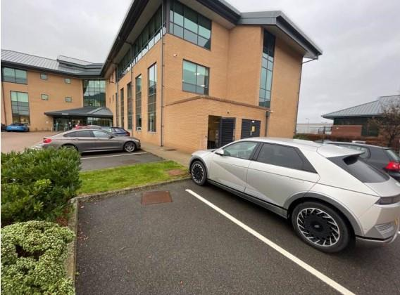
Pegasus House and the existing car-park environment assessed before design development.

Why the planning decisions mattered

Project consideration
Why it mattered

Live environment

Groundworks and electrical work had to preserve safe access to an operational office and car park.

Future expansion

Ignoring future demand could mean repeated excavation and duplicated capital expenditure.

Electrical capacity

Available three-phase power needed to be shared responsibly across connected vehicles.

User experience

Occupiers and visitors needed dependable access, payments and clear operating arrangements.

Operational readiness

Software, reporting, inspection, maintenance and handover had to be planned before launch.

2.

Survey the Whole Site

The planning challenge

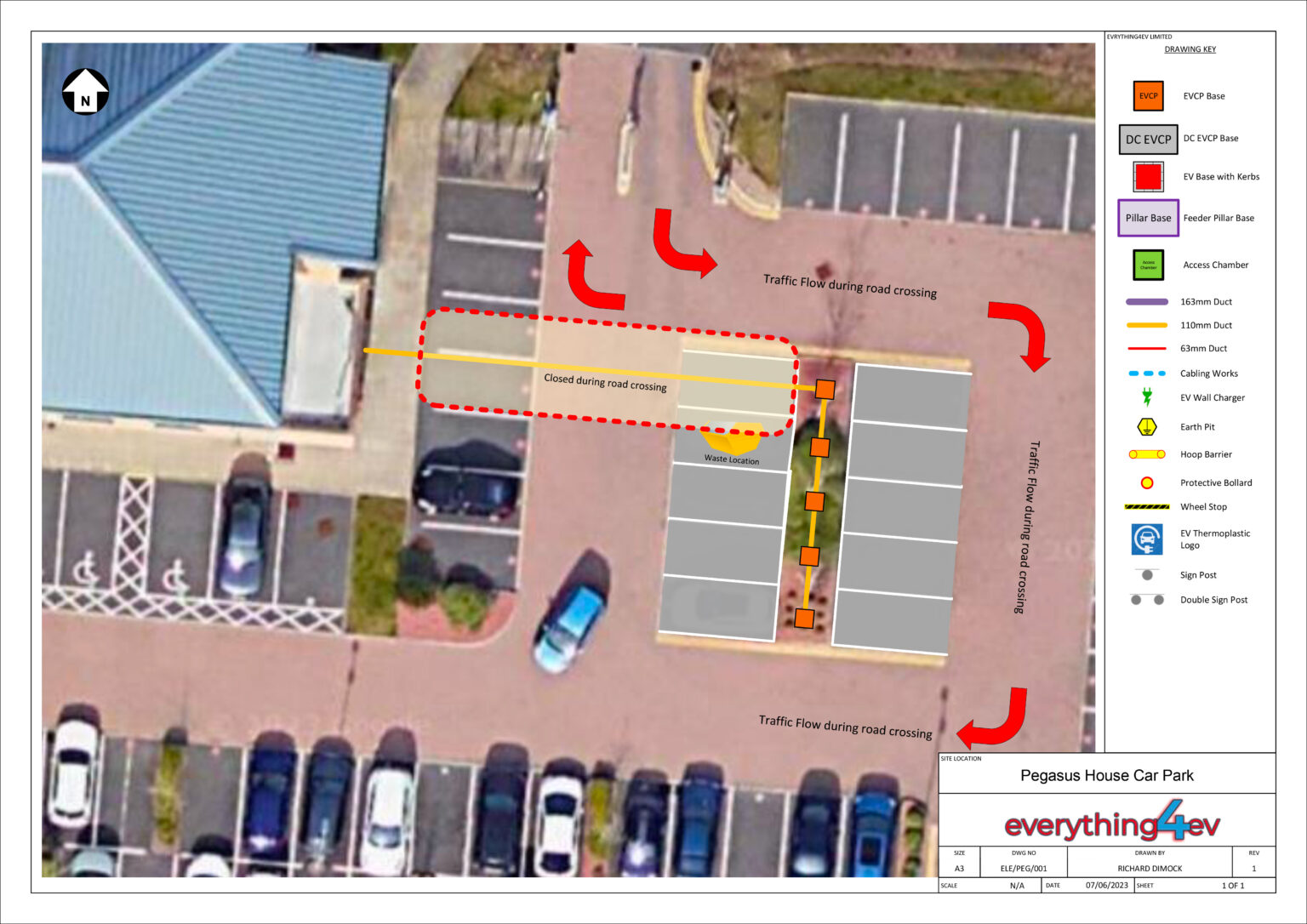
Electric Spinach assessed the distribution equipment, approximately 30-metre route to the charging area, surface types, parking layout, pedestrian and vehicle movement, connectivity, ground conditions and future maintenance access. The preferred design used two 63 A three-phase radial circuits, each serving three chargers. Dynamic power sharing allowed charging output to be balanced as more vehicles connected.

Knowledge Hub Connection

The survey answered the three core Planning & Installation questions: what to consider before installing, how to choose suitable chargers and how to future-proof the infrastructure.

Planning inputs assessed together

Users & access

Staff, occupiers, contractors and visitors

Power & load

Supply, circuits and dynamic power sharing

Location & routing

Surfaces, traffic and pedestrian movement

Hardware & software

Connectivity, access, billing and reporting

Safety & resilience

Protection, isolation and physical risk

Future demand

Ducting and positions for four more chargers

3.

Design a Coordinated Solution

The Standard™ connected the commercial objective to the final handover, ensuring that electrical design, civil works, safety, software, future capacity and operational responsibilities were considered together.

How the Standard™ was applied

Six project stages

1. Define

Objectives, users, access and demand

2. Survey

Supply, location, routes and constraints

3. Design

Electrical, civil, safety and software

4. Deliver

Sequence works around the live site

5. Verify

Test, commission and certify

6. Hand over

Records, access and responsibilities

Key planning decisions

Design around real use

Workplace dwell times and available power mattered more than maximum headline output.

Protect future options

Spare ducting and two additional dual-post positions were installed during the first excavation.

Coordinate hardware and software

Easee hardware and Fuuse software were selected together to support access, billing and reporting.

Treat documentation as an asset

Certification, commissioning records and handover information were planned as operational tools.

4.

Integrate Risk Considerations

Insurance-informed planning

The planning process considered relevant Zurich Resilience Solutions guidance as an insurer-informed risk checklist. This was not represented as formal Zurich approval. The review helped test location, access, signage, electrical protection, emergency arrangements, physical protection and ongoing inspection responsibilities.

Risk considerations and responsibilities

Risk consideration
Project response
Ongoing responsibility

Location & movement

External charging area; parking, pedestrian interaction and traffic flow considered.

Keep access routes and charging bays unobstructed.

Electrical protection

Dedicated EV distribution, RCD arrangements, surge protection, PEN-fault protection and isolation considered.

Maintain inspection, testing and fault-isolation procedures.

Impact & cable protection

Post mounting and protective measures considered within the car-park design.

Check physical condition through routine inspections.

Signage & emergency information

Safety, operating and emergency information included within project requirements.

Facilities Management to retain and update site instructions.

Staff awareness

Fault escalation and emergency shutdown responsibilities recognised.

Maintain local procedures and staff awareness.

5.

Deliver the Infrastructure

Civil and electrical works

The route crossed paving, soft landscaping, tarmac and block paving. Surfaces were carefully opened and reinstated while maintaining safe movement around the live site. Additional ducting and mounting provision were installed for four future chargers during the same works.

Two 63 A three-phase supplies served a dedicated EV distribution arrangement. Six Easee charge points were installed across three dual posts, with the required electrical protection and isolation measures incorporated into the design.

Charging access and management

Fuuse provided the back-office platform, supporting RFID, app and QR-code access, user billing, reporting and charger-performance visibility. Electric Spinach also managed the applicable grant process and secured £7,100 towards active chargers and enabling infrastructure.

6.

Verify and Hand Over

The completed installation was inspected, tested and certified to the edition of BS 7671 applicable at the time: BS 7671:2018+A2:2022. Operational checks also covered charger functionality, connectivity, software access and the information required for ongoing management.

The Result

Six chargers today. A planned route to ten.

Rather than receiving six isolated charge points, Pegasus House gained a managed workplace charging service and a planned route to ten chargers. First-phase expansion provision and £7,100 of grant support reduced current cost and future disruption, while electrical design, software, risk considerations, certification and handover were treated as one infrastructure decision.

Delivering the five operational principles

Together, these measures reflect the Standard’s wider philosophy of operational stewardship: plan beyond commissioning, protect the client’s investment and keep looking ahead.

Compliance

Dedicated EV distribution, protection, inspection, certification and documented handover

Uptime

Commissioning, connectivity and support arrangements created the foundation for dependable operation

Interoperability

Easee hardware and Fuuse software selected together to support access, billing and reporting

Operational visibility

Fuuse provides usage, billing and charger-performance oversight

Lifecycle management

Provision for four future chargers, with maintenance requirements considered before handover

Stewardship

Electric Spinach coordinated objectives, surveying, risk considerations, funding, installation, commissioning and future-readiness to protect long-term client value.

Lessons for Property Owners and Facilities Teams

Start with users and objectives

Define who will charge, how long vehicles will remain and how access will work before selecting hardware.

Assess the complete site

Power, routes, connectivity, safety, traffic and future maintenance all affect the design.

Future-proof the expensive parts

Spare ducting and mounting provision can reduce the cost and disruption of later expansion.

Plan operation before launch

Billing, reporting, inspection, support and emergency responsibilities should be agreed before commissioning.

Evidence base

The project was planned and delivered with consideration to the requirements and guidance relevant to its scope:

Related Planning & Installation guidance

What should you consider before installing commercial EV chargers?

Users, power, location, routes, connectivity, safety, software and future operation were assessed together.

The selected system reflected dwell time, available capacity, managed power sharing, access, billing and support.

Ducting and mounting provision were installed for four additional chargers during the first civil works.

Planning commercial EV infrastructure?

Electric Spinach helps property owners, managing agents and facilities teams plan, install and operate future-ready EV charging infrastructure through the Electric Spinach Standard™.

Book an EV infrastructure review